Road Trips – the all-American summer ritual. Whether it’s for that wholesome, laughable family vacay National Lampoon style, or you’ve embraced hipster #vanlife, or you’re going on a trippy cross country journey of self discovery a la Jack Kerouac – somehow this has become part of Americana. Probably because in practical terms road trips are often the cheapest way to get across the expanse of these United States.
But if you’ve landed on this page, chances are you hate road trips. Or at least find them physically very taxing and painful. And yet – you can’t escape them.
I went from being the road trip queen (I helped almost all of my college roommates drive to or from school) to having road trip PTSD. Actual PTSD that had to be managed. It’s a real bummer when you live in Alabama and most places you want to go are 3-15 hours of road time. Over the course of 12 years I’ve finally got my road trip game down to a science and I’m going to share what I do to manage pain and minimize injuries during the drive. These hacks will help anyone with a connective tissue disorder, hypermobility, or chronic pain due to issues such as MS and Fibromyalgia.
I’m going to describe how my setup supports 1) The Seat 2) The Feet 3) The Upper Body and 4) The Mind.
For a quick video tutorial and finished product, click here to head to TikTok.
The Seat
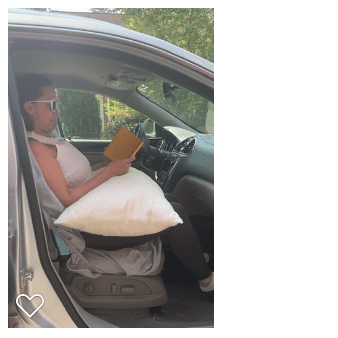
This seat is a DIY creation. We had an old memory foam mattress topper (originally purchased at Costco). It still had some life left in it, so I took a knife and cut it up to provide me a cushion to sit on and against. It’s quite easy to cut using a serrated knife. I did not measure this – I just went at it and started with a size that was obviously too big, paring it down to the size I needed in about 2 iterations.
The padding behind me provides obvious cushioning, but more importantly it stabilizes me against the bumps and jostling that can cause micro injuries during a car trip (even a trip to the local grocery store). This made even more of a difference than I expected, especially for my neck and ribs.
The padding below me provides cushion and support for my pelvic floor. Pelvic organ prolapse and rectal prolapse mean that hours of sitting in the car become extremely painful and can lead to damage. Nothing thwarts a vacation like starting off with a bowel obstruction from the ride. This homemade seat cushion has been the most effective in minimizing pain to my pelvic floor and preventing increased prolapse by the end of the ride.
Because memory foam on skin isn’t the most sensory pleasing or comfy thing, and because it’s nice to have a surface you can wash, I used an inexpensive crib sheet to cover the cushions. The added benefit is that it helps keep the cushions more securely in place.
The Feet
I wear shoes with proper arch support during the ride. When you’re hypermobile, it’s possible to essentially sprain your ankle just sitting in one place. In addition, the general principle that the feet set the alignment for the rest of the body is still true, even when you’re sitting. It’s important to prevent ankle sickling and the best option for the car I’ve found are crocs. Easy on and off. Gentle arch. Some added cushioning. The rubber sole is nice and grippy against the footrest.
The footrest ensures that my ankles aren’t extended reaching towards the ground and they help set my hips and low back in their proper place. Instead of pulling into an arched or slipping into a slouched position over the course of the driving day, my ankles, knees, hips and low back remain in neutral. This in turn allows my muscles to stay relaxed for longer, preventing or at least minimizing the extreme muscles spasms I used to end up with after a day on the road.
The Upper Body
This is actually the first hack I tried / introduced. It was recommended by my physical therapist. At the time, they used a nursing pillow to provide the support. That is a bit heavy and unwieldy. Using a king size pillow works better and the bonus is, I have a pillow from home to use on the trip once I arrive.
Supporting the upper body like this and providing yourself with an arm rest helps better position the shoulder, head and neck, which you would expect. The unexpected bonus effect is that it takes pressure off your abdominal muscles and low back, helping prevent strain of your hip flexor muscles and minimizing low back pain.
During my yoga teacher’s training, the instructors would often say “your abs are the front of your back.” This is a great example of that principle. The support over the abdominal wall protects the lower back.
The Mind
I have lots of PTSD triggers, and road trips are one. I mean this literally, not as comic hyperbole. I’ve had some pretty epic injuries and pain cycles from time spent in the car – driving to and from painful medical procedures – 13 hour rides that ended in bowel obstructions – etc. Muscle relaxers are not a safe tool for me on road trips. I need my muscles firing to keep me as stable as possible, even with the seat cushions, footrest and support. A doctor did proscribe some quick acting anxiety meds and this was a helpful tool in the season before I felt confident about road travel again. My muscles have benefitted from calming my mind much more than the other way around in the context of road trips. I still use them occasionally when I know I won’t be called on as a driver.
The other key is mental distraction. I always make sure I have a new book to dive into on the trip. This usually helps me pass time and keeps my mind engaged. Besides – I’m someone who loves to read a book straight through. It’s an unusual treat to be able to spend so much un-interrupted time reading.
The Results
I rate this life hack 25,000 out of 5 spoons. My road trip arc changed from queen, to barely surviving by taking breaks to lay in a grass median next to a gas station, to total avoidance, to the ability to plan successful road trips where I overcome the journey to enjoy the destination.